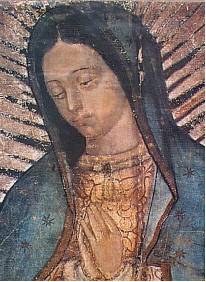
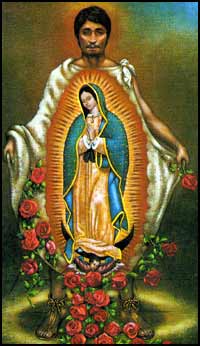
The Image on the tilma is not just a painting. It is a recapitulation of the message that Juan Diego experienced, saw, and heard at Tepeyac. In the native cloth of Juan Diego’s tilma - the fiber of the clothing of the poorest of the poor of the conquered and dominated people - the image of the unlimited and very personal love and compassion of the new center of all life and of the universe made its dwelling among us. Like the biblical word that was written on paper made by human hands in a specific place, God’s word was painted on the native cloth of indigenous America. Like in the biblical word, it would be there for all generations to "read" for our salvation. What the written word has been for generations of biblical believers, the painted word has been for generations of believers in the New World. In Our Lady of Guadalupe at Tepeyac, God pitched a tent and came to dwell among us. The Word became flesh of the Americas through Our Lady of Guadalupe and dwells amoung us truly as one of us."
(Except from the book ‘Guadalupe, Mother of the New Creation')*
His native name was Cuauhtlatoatzin, which could be translated as “One who talks like an eagle” or “eagle that talks”.
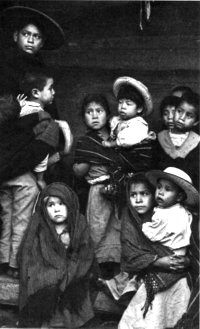
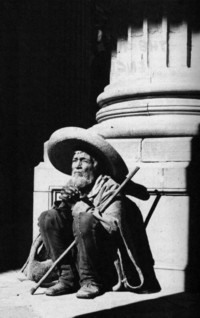
The Nican Mopohua describes him as a 'macehualli' or “poor Indian”, one who did not belong to any of the social categories of the Empire, as priests, warriors, merchants,...but not a slave; a member of the lowest and largest class in the Aztec Empire. When talking to Our Lady he calls himself “a nobody”, and refers to it as the source of his lack of credibility before the Bishop.
He devoted himself to hard work in the fields and manufacturing mats. He owned a piece of land and a small house on it. He was happily married but had no children.
Between 1524 and 1525 he was converted and baptized, as well as his wife, receiving the Christian name of Juan Diego and his wife the name of Maria Lucia. He was probably baptized by the famous and loved Franciscan missionary Fray Toribio de Benavente, called “Motolinia”, or “the poor one”, by the Indians for his extreme kindness and piety.
According to the first formal investigation by the Church about the events, the Informaciones Guadalupanas of 1666, Juan Diego seems to have been a very devoted, religious man, even before his conversion. He was a solitary, mystical character, prone to spells of silence and frequent penance and used to walk from his village to Tenochtitlan, 14 miles away, to receive instruction on the doctrine.
His wife Maria Lucia became sick and died in 1529. Juan Diego then moved to live with his uncle Juan Bernardino in Tolpetlac, which was closer (9 miles) to the church in Tlatelolco -Tenochtitlan.
He walked every Saturday and Sunday many miles to church, departing early morning, before dawn, to be on time for Mass and religious instruction classes. He walked on naked feet, as all the people of his class, the macehualli. Only the higher social classes of the Aztecs wore cactlis, or sandals, made with vegetal fibers or leather. He used to wear in those chilly mornings a coarse-woven cactus cloth as a mantle, a tilma or ayate made with fibers from the maguey cactus. Cotton was only used by the upper Aztec classes.
During one of this walks to Tenochtitlan, which used to take about three and a half hours between villages and mountains, the First apparition occurred, in a place that is now known as the “Capilla del Cerrito”, where the Blessed Virgin Mary talked to him in his language, Nahuatl. She called him “Juanito, Juan Dieguito “, “the most humble of my sons”, “my son the least”, “my little dear”. He was 57 years old, certainly an old age in a time and place where the male life expectancy was barely above 40.
After the miracle of Guadalupe, Juan Diego moved to a room attached to the chapel that housed the sacred image, after having given his business and property to his uncle; and he spent the rest of his life propagating the account of the apparitions to his countrymen.
He died on May 30, 1548, at the age of 74. Juan Diego deeply loved the Holy Eucharist, and by special permission of the Bishop he received Holy Communion three times a week, a highly unusual occurrence in those times. Pope John Paul II praised Juan Diego for his simple faith nourished by catechesis and pictured him (who said to the Blessed Virgin Mary: “I am a nobody, I am a small rope, a tiny ladder, the tail end, a leaf”) as a model of humility for all of us.
You couldn't help but love Charlene Gallegos. She, her husband Ken and their two children Cristin & Justin, lived on the outskirts of Greeley, Colorado. Their home was always open for discussion groups and, in fact, that is where our community, known as OUR MOTHER OF THE AMERICAS, Virgil Elizando's name for Our Lady in his book Guadalupe, Mother of the New Creation,

 had its beginnings;
around the dining room table. There were only six or seven of us, and we
celebrated the Holy Eucharist. I have often compared that early beginning
with Jesus at the inn at the end of the journey to Emmaus. I had asked the
Lord for numbers. I wanted to tell everyone that it was not enough to know
ABOUT Jesus, but that it was our privilege to KNOW Jesus! To walk with
Him. To talk with Him, and yes even to comfort him as we remembered the
events in His life, His dying for us, but that He was alive and that He
lived in each of us and all of us. But God obviously did not want me to
shout out the good news in a large assembly, but to whisper it gently to
those with eager ears. That was the Gallegos family. Charlene not only
lived the Gospel, she was the Good News, and from her very special place
with the Lord, she is still teaching us. There are far too many events to
be spilled out in this limited space, but in her final days, even in her
suffering with cancer, she had an ear and an eye for someone who needed a
helping hand. She bought a copy of the movie PAY IT FORWARD and saw that
everyone she knew had the opportunity to view it, and to hopefully live
into its message of love and hope, and even sacrificial death. Today, I
know that Char is laughing with the angels and probably trying the Lord's
patience if there is anyone at all that just might be overlooked in the
rush for compassion, for Char is as compassionate as her Heavenly
Father.
had its beginnings;
around the dining room table. There were only six or seven of us, and we
celebrated the Holy Eucharist. I have often compared that early beginning
with Jesus at the inn at the end of the journey to Emmaus. I had asked the
Lord for numbers. I wanted to tell everyone that it was not enough to know
ABOUT Jesus, but that it was our privilege to KNOW Jesus! To walk with
Him. To talk with Him, and yes even to comfort him as we remembered the
events in His life, His dying for us, but that He was alive and that He
lived in each of us and all of us. But God obviously did not want me to
shout out the good news in a large assembly, but to whisper it gently to
those with eager ears. That was the Gallegos family. Charlene not only
lived the Gospel, she was the Good News, and from her very special place
with the Lord, she is still teaching us. There are far too many events to
be spilled out in this limited space, but in her final days, even in her
suffering with cancer, she had an ear and an eye for someone who needed a
helping hand. She bought a copy of the movie PAY IT FORWARD and saw that
everyone she knew had the opportunity to view it, and to hopefully live
into its message of love and hope, and even sacrificial death. Today, I
know that Char is laughing with the angels and probably trying the Lord's
patience if there is anyone at all that just might be overlooked in the
rush for compassion, for Char is as compassionate as her Heavenly
Father.God Bless,
Fr George Hendricks